A woman in the phlebotomy training class had been doing well, and then not. Then she dropped out completely.
Staff figured out the problem: She had become homeless. They put her in touch with an agency that could help. She got a place to live, she returned to the phlebotomy program, she graduated, and she is now gainfully employed.
That story — of lifting up people whose lives are on the edge to new skills, new self-esteem, and success — was told Wednesday as an example of the kidn of life-changing work that is getting a $1 million boost.
The boost is coming in the form of a grant from KeyBank to the Connecticut Center for Arts and Technology (ConnCAT) in Science Park.
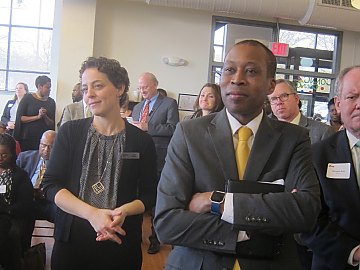
About 75 philanthropic movers and shakers and political officials marked the occasion at a press conference convened at the Orchid Cafe. That’s the restaurant, at ConnCAT’s 4 Science Park headquarters, run by students in the culinary training program.
That program, along with training in phlebotomy and medical coding and billing, are the specific beneficiaries of the Key grant, said ConnCAT President and CEO Erik Clemons.
At any one time about 57 students are involved in ConnCAT’s intensive job training programs, which run four months for the phlebotomy classes; six months for the culinary arts; and eight months to complete certification in medical coding and billing.
In a brief tour of the classes Wednesday, before the formal speeches began in the cafe, we met Pierre Goubourn, a graduate of the phlebotomy program himself back in 2012. He now teaches the course.
“What is a tumor of the gland?” he called out to a particular student.
ConnCAT Board Chairman Carlton Highsmith said that since the day the center opened, not a dollar of government money at any level has been solicited or spent. The entire operation depends on grants from individuals, corporations, and foundations.
ConnCAT finds transforming pathways for people whom other programs might have given up on. When staffers found, for example, that most of those enrolled in the medical programs were women, they did a market study and found that New Haven’s booming restaurant scene needs people able to step instantly into a kitchen and know what to do.
That’s how the culinary arts program was established. In no small part, those attracted to it were men, many formerly incarcerated.
The “Hope Business”
“We’re in the hope business. We’re in the business of turning liabilities into assets,” Highsmith added.
The culinary arts job placement rate is 100 percent. For those training in the medical field, it’s 64 percent thus far, Clemons reported.
KeyBank Foundation CEO and Chairperson Margot Copeland, who formally presented the check, agreed. She called the gift a “smart investment” and ConnCAT’s program potentially a national model for job training and reeducation.
“It’s not training people in a vacuum but for real jobs to be skilled people who transform their lives,” she added.